Somewhere around the second or third year, the question changes shape. It stops being “does she like it?” and becomes “where does this actually go?”
It is a fair question, and it usually gets asked late at night with a search bar open. The trouble is that almost everything that comes back is about a different sport.
Here is the honest answer, including the part that does not help us.
What parents find when they search, and why it does not apply
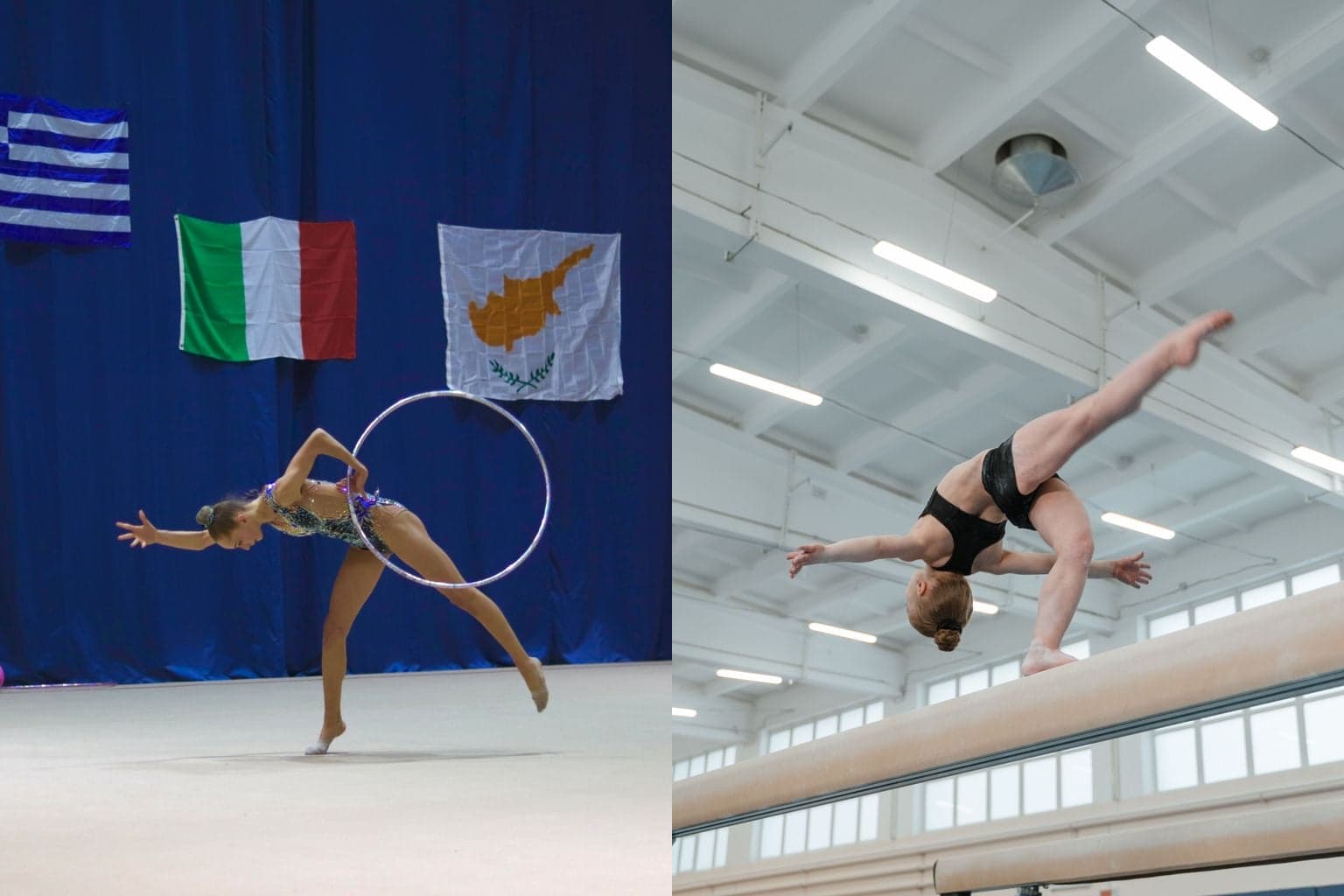
Search for college gymnastics and you land in artistic gymnastics. The NCAA runs a National Collegiate Women's Gymnastics Championship, contested on vault, uneven bars, balance beam, and floor exercise. Those are four artistic events. None of them is her sport.
The confusion is reasonable. Both are called gymnastics, both are governed here by USA Gymnastics, and if you have not seen the two side by side they blur together. We wrote about how the two sports differ if that part is still fuzzy. But the NCAA gymnastics pathway that gets recruited for and televised is artistic gymnastics. The NCAA's own sport sponsorship tables list women's gymnastics as a championship sport across all three divisions. Rhythmic gymnastics is not listed as an NCAA sport at all.
The straight answer
The NCAA does not sponsor rhythmic gymnastics, so there is no NCAA varsity rhythmic gymnastics pathway, no NCAA rhythmic gymnastics championship, and no rhythmic-specific athletics scholarship pathway. Athletics scholarships are awarded by colleges and their coaches rather than by the NCAA, and what is offered depends on the sport, the division, and the school. As of August 2026 the National Association of Intercollegiate Gymnastics Clubs, which runs collegiate club gymnastics, states that its competitions cover women's artistic, men's artistic, and trampoline and tumbling, plus a combined format called Decathlon. Rhythmic is not among them.
There are two things that answer does not say, and it is worth being precise about both, because imprecision here misleads families in the other direction.
It does not say your daughter cannot earn a scholarship. Academic scholarships, merit scholarships, private awards, and aid from an individual school follow their own eligibility rules, so check each one separately rather than assuming either way.
And it does not say that no college student anywhere does rhythmic gymnastics. Individual university clubs start and fold, and nobody could honestly claim to know every one of them. The claim here is narrow and specific: the NCAA does not sponsor rhythmic gymnastics, so there is no NCAA varsity rhythmic gymnastics pathway, no NCAA rhythmic gymnastics championship, and no rhythmic-specific athletics scholarship pathway. If a particular school matters to your family, ask that school directly rather than trusting any general answer, including this one.
What we would rather you hear from us
We will be straight with you. If an NCAA athletic scholarship in rhythmic gymnastics is the plan, there is no such pathway to aim at, and it is better to know that in her first year than in her tenth.
That is not the same as saying the sport leads nowhere. It means one specific door, the one artistic gymnastics has, is not in this building. A family who spends years training toward a door that was never there has been let down by somebody, and we would rather it was not us.
Where the sport actually tops out
The competitive ladder in this country is real. It is just shaped differently. USA Gymnastics runs a Development Program (DVP) covering pre-competitive levels 1 and 2 and competitive levels 3 through 8, and it exists to prepare a gymnast for the Elite Program, which covers Junior and Senior levels 9 and 10 and elite athletes competing nationally and internationally under FIG and USA Gymnastics rules.
At the top of that pathway are the national championships, the national team, and international competition. That is the ceiling in rhythmic gymnastics, and it is a real one. It is also narrow, the way the top of any sport is narrow. Our competitive program page lays out how the levels fit together, and our guide to the competitive path covers what it asks of a family week to week.
Why families do it anyway
So why does anyone stay?
Because the question a family starts with may not be the one that ends up mattering. What a girl takes out of this sport is not a roster spot. It is having worked at something for months with nothing visible to show for it, and then having it arrive. It is walking onto a floor to be scored by people she has never met. It is spending her afternoons somewhere the standard is high and nobody quietly lowers it for her.
Whether that is worth years of training is a judgment only your family can make. We have written separately about what the research does and does not support on the confidence side. We are biased, obviously. We would still rather you weigh this with the college question answered accurately than left to assume.
Common questions from parents
Is rhythmic gymnastics an NCAA sport?
No. The NCAA's own sport sponsorship tables list women's gymnastics as a championship sport and do not list rhythmic gymnastics at all. The NCAA runs a National Collegiate Women's Gymnastics Championship, and it is artistic gymnastics, contested on vault, uneven bars, balance beam, and floor exercise.
Is there an NCAA athletic scholarship for rhythmic gymnastics?
No. The NCAA does not sponsor rhythmic gymnastics, so there is no NCAA varsity rhythmic gymnastics pathway, no NCAA rhythmic gymnastics championship, and no rhythmic-specific athletics scholarship pathway. Athletics scholarships are awarded by colleges and their coaches rather than by the NCAA, and what is offered depends on the sport, the division, and the school. Academic scholarships, merit scholarships, private awards, and aid from an individual school follow their own eligibility rules, so families should check each one separately.
Can she compete in rhythmic gymnastics after high school?
Competing at college age is a different question from competing on an NCAA varsity team. As of August 2026 the National Association of Intercollegiate Gymnastics Clubs, which runs collegiate club gymnastics, states that its competitions cover women's artistic, men's artistic, and trampoline and tumbling, plus a combined format called Decathlon. Rhythmic is not among them. Individual university clubs start and fold, so a family who wants this should ask the specific school rather than rely on a general answer.
If there is no NCAA path, why compete at all?
Because for some families the scholarship question turns out not to be the one that mattered. Competing asks a girl to work at something for months without visible progress, to perform in front of judges, and to hold a standard nobody lowers for her. None of that requires a roster spot, and whether it is worth the years is a judgment your family makes for itself.
See the sport before you weigh the ceiling
If you are trying to decide whether this is worth your daughter's next few years, more reading will not settle it. One class will tell you more. Book a free trial class at our McKinney or Frisco studio, or request an evaluation if she already trains and you want to know where she would start. If she is brand new, our Beginners Program is the place to begin.