
Preschool Program
A joyful introduction to rhythmic gymnastics where young children build coordination, confidence, and a love for movement through dance, music, and play.
- 60-Minute Classes
- Ages 3-5
Where the Journey Begins
Our Preschool Program welcomes children aged 3 to 5 into a safe, supportive environment where they discover rhythmic gymnastics through guided play and structured activities. Classes meet on Saturday mornings at our McKinney studio.
Unlike tumbling or artistic gymnastics, rhythmic gymnastics at this age is entirely dance-based. There are no handstands, cartwheels, or flips. Instead, children learn to move gracefully with music, handle colorful apparatus like ribbons and balls, and develop body awareness through creative expression.
Our certified instructors are trained in both rhythmic gymnastics and early childhood development. They use positive reinforcement, patience, and redirection - creating an atmosphere where every child feels encouraged and excited to learn.
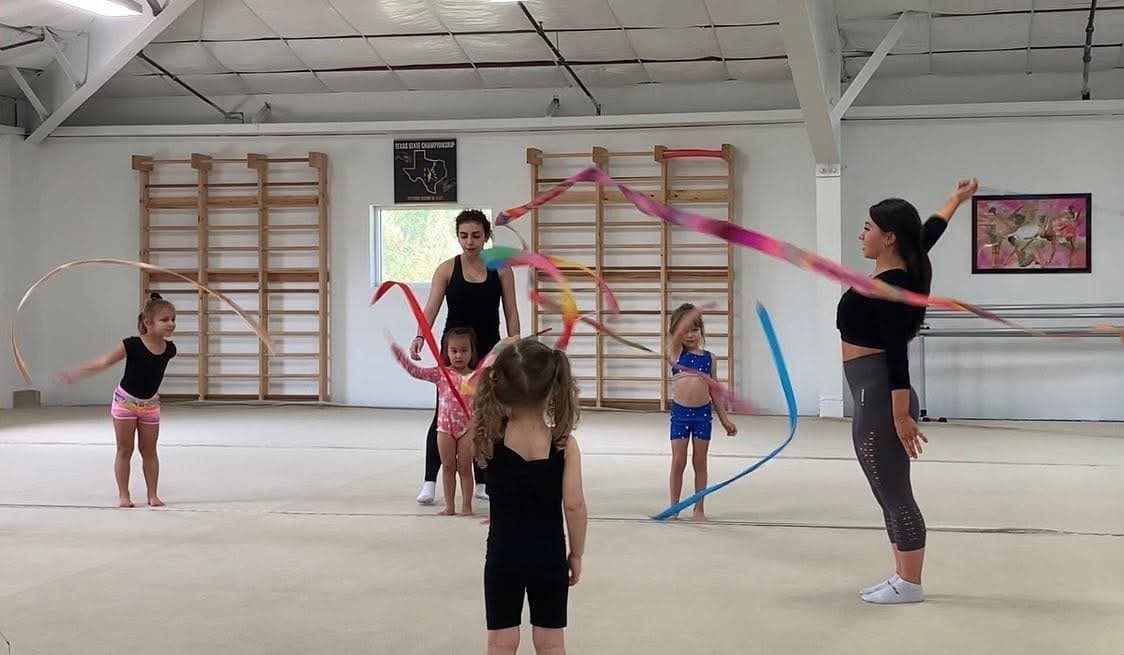
What a Class Looks Like
Each 60-minute session follows a structured flow designed to keep young children engaged, with water breaks built in along the way.
Arrival & Warm-Up
Children ease into the gym with free exploration and active songs. Marching, galloping, tiptoeing, and animal walks like bear crawls and frog jumps get bodies moving and help with the transition from home.
Guided Stretching
Seated stretches in a circle using names kids remember - butterfly stretch, pizza stretch, straddle reach. Coaches work on early splits preparation, back flexibility, and basic body positions in a playful way.
Skill Stations & Apparatus Play
The heart of class. Children rotate through 4-6 stations - forward rolls, ribbon spirals, ball rolling, hoop play, releve balance practice, and dance steps. Each station is visited twice so skills start to stick.
Cool-Down & Goodbye Circle
Gentle stretching, a closing song, and a moment for coaches to share feedback with parents about what their child practiced that day.
Age-Appropriate Apparatus
Preschoolers use modified, child-sized equipment designed for safety and success. Competition-sized apparatus and clubs are introduced later in the competitive track.
Scarves & Streamers
The most beginner-friendly prop. Lightweight and visually rewarding, scarves teach children to wave, circle, and figure-eight, building arm coordination and spatial awareness.
Balls
Smaller and softer than competition balls. Children practice rolling, bouncing, and tossing - developing hand-eye coordination and bilateral control in a way that feels like play.
Short Ribbons
Shorter than competition ribbons, which are at least 5 meters for juniors and 6 for seniors. Children learn spirals, snakes, and circles, building wrist control and whole-arm coordination with one of the most exciting apparatus.
Small Hoops
Lighter and smaller than competition hoops. Children roll them, step through them, and spin them on their arms - learning spatial awareness and timing through guided exploration.
What Your Child Develops
Motor Skills
- Bilateral coordination (using both sides of the body together)
- Hand-eye coordination from apparatus handling
- Balance and proprioception (body awareness in space)
- Fine motor control from gripping and manipulating equipment
Cognitive Growth
- Moving to music helps children learn to remember and follow sequences
- Crossing the midline (reaching right hand to left side and vice versa) supports brain development
- Understanding where their body is in space - a skill that carries into reading, writing, and math
- Counting, sequencing, and following multi-step instructions
Social & Emotional
- Following group instructions and taking turns
- Self-confidence from performing in front of peers
- Creative expression through music-driven movement
- Patience with repetition and delayed gratification
Skills Milestones by Age
Every child develops at their own pace. These are typical milestones, not requirements - they give you a sense of the progression your child will experience.
Age 3
- ✓Follow simple one-step instructions from a coach
- ✓Hold a basic balance on one foot with assistance
- ✓Wave a scarf in circles and figure-eights
- ✓March and gallop to music
- ✓Stand on one foot for 2-3 seconds
- ✓Basic body shapes: tuck, star, straight
Age 4
- ✓Follow 2-3 step movement sequences
- ✓Forward roll independently
- ✓Walk in releve (on toes) along a line without assistance
- ✓Basic ball skills: roll, bounce, toss and catch
- ✓Skip and chasse (side-step)
- ✓Hold a releve (standing on toes) for 3-5 seconds
- ✓Beginning splits training
Age 5
- ✓Execute short choreographed routines (8-12 counts)
- ✓Ball toss and catch, roll along arms, rhythmic bouncing
- ✓Ribbon spirals, large circles, and tosses
- ✓Hoop spinning on hand, rolling, and passing through
- ✓Basic jumps and split-jump preparation
- ✓Body waves and improved flexibility
- ✓Understanding of basic rhythmic counting (1-2-3-4)
How It Differs from Tumbling Classes
Parents often wonder how rhythmic gymnastics compares to the tumbling or artistic gymnastics classes they see at other facilities. The two disciplines are quite different, especially at the preschool level.
| Rhythmic Gymnastics | Artistic / Tumbling | |
|---|---|---|
| Core Focus | Grace, flexibility, rhythm, expression, apparatus handling | Strength, power, acrobatic skills, vault, bars, beam |
| Equipment | Handheld props (ribbon, ball, hoop, rope, scarves) | Fixed apparatus (bars, beam, vault, rings, floor) |
| Music | Every routine is performed to music - it's central to the sport | Music only used in women's floor exercise |
| Movement Style | Dance-based: ballet, body waves, leaps, flowing transitions | Acrobatic: flips, handsprings, cartwheels, tumbling passes |
| At This Age | No handstands, cartwheels, or flips | Handstands and cartwheels are foundational |
| Physical Demand | Dance-based movement with handheld apparatus | Tumbling passes and repeated landings |
What Parents Should Know
What to Bring & Wear
- ✓A leotard is ideal - or fitted athletic clothing that won't ride up during movement
- ✓Hair tied back securely in a ponytail or bun
- ✓No jewelry of any kind (bracelets, earrings, necklaces can snag or cause injury)
- ✓A water bottle (two scheduled water breaks per class)
- ✓Use the restroom before class starts
The Adjustment Period
It is completely normal for children to take several classes before they fully engage. Some children prefer to observe before participating - this is expected and healthy.
Crying or clinging at drop-off is common early on, and it often eases once class is underway. Our coaches are trained in child development and know how to help children feel safe and excited.
Arrive 10-15 minutes early for the first class to complete paperwork and let your child get comfortable with the space.
Why Start Early?
Starting at three gives a girl years to grow into the sport before anything is asked of her. Class is where she learns to listen in a group, take turns, and follow along, and she picks all of that up through play with scarves, ribbons, and small hoops rather than through drills. Plenty of our gymnasts start later instead, and our Beginners Program takes new starters from 5 through 18.
The combination of movement with music and colorful props makes rhythmic gymnastics uniquely engaging for this age group, where attention spans are short but sensory stimulation drives learning.
Curious if it's a fit? Book a free preschool trial class in McKinney for ages 3-5.
Ready to Get Started?
Join us for a free trial class and experience the joy of rhythmic gymnastics.